Foreign Corporate Records and Apostilles for E-2 Petitions: What You Need to Know
Foreign corporate records and apostilles are essential for E-2 visa petitions. Learn what documents you need, how to obtain apostilles, and common mistakes to avoid.
- Filed
- Reading time
- 10 min · 2,385 words
- Counsel of record
- Christian M. Frank Fas, Esq.
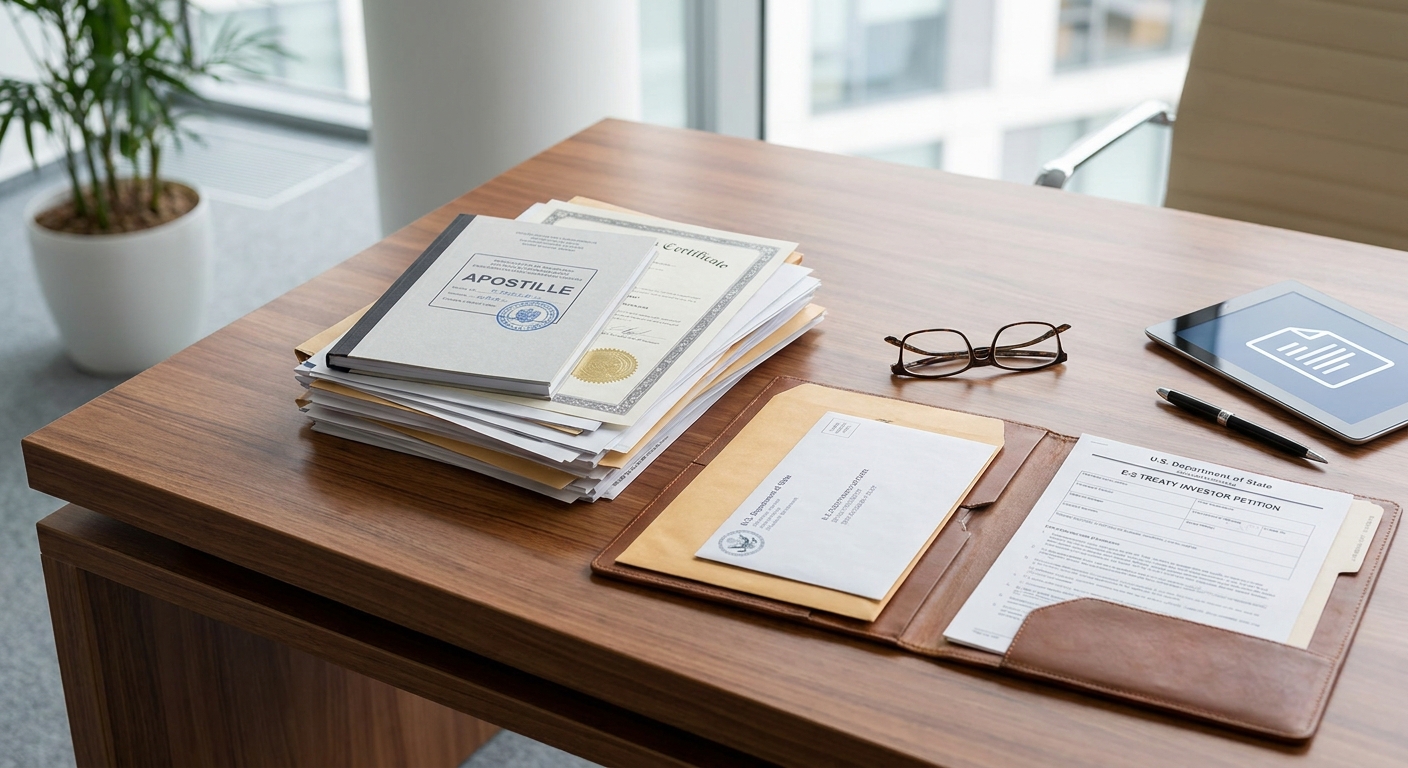
Why Foreign Corporate Documentation Matters for Your E-2 Visa Application
The U.S. Citizenship and Immigration Services (USCIS) requires comprehensive proof that your business is legitimate, properly established, and capitalized with real funds. When you are a foreign national seeking an E-2 visa, the burden of proof falls on you to demonstrate that your company exists as a legal entity in your home country and that you have the authority to represent it in the United States. This documentation requirement is not optional, and incomplete or improperly authenticated records will result in a Request for Evidence (RFE) or outright denial.
Foreign corporate records serve as the foundation of your E-2 petition. They establish your ownership stake, your role within the company, and the legitimacy of the capital you are investing in your U.S. business venture. Without proper documentation, USCIS has no way to verify that you actually own the company or that the funds you claim to be investing are genuinely yours to invest. This is where apostilles become essential.
Understanding Foreign Corporate Records
Foreign corporate records are official documents issued by your home country’s government or authorized business registry that confirm your company’s legal status. These records vary significantly depending on your country of origin, the type of business entity you operate, and the specific requirements of your jurisdiction.
Common types of foreign corporate records include:
- Articles of incorporation or formation
- Certificates of good standing
- Corporate bylaws or operating agreements
- Board resolutions authorizing the E-2 investment
- Shareholder or member certificates
- Tax registration documents
- Bank statements showing capitalization
- Corporate registry extracts or certified copies
Each of these documents serves a specific purpose in your E-2 petition. Articles of incorporation prove that your company legally exists. Certificates of good standing confirm that your company is in compliance with all regulatory requirements in your home country. Board resolutions demonstrate that your company’s leadership has formally authorized the investment in your U.S. business. Shareholder certificates establish your ownership percentage and voting rights.
The challenge is that USCIS does not simply accept photocopies or digital scans of these documents. The agency requires certified copies obtained directly from the issuing authority in your home country. In many cases, these documents must also be translated into English by a certified translator if they are in another language. Translation alone is not sufficient, however. The documents must also be authenticated through a process called apostille.
What Is an Apostille and Why Is It Required
An apostille is an official certification that authenticates the origin of a public document. It is issued by a designated authority in the country where the document was created. The apostille certifies that the signature, seal, or stamp on the document is genuine and that the person who signed it held the official position they claimed to hold at the time of signing.
The apostille system was established by the Hague Apostille Convention of 1961, an international treaty that simplifies the authentication of documents for use in other countries. The United States is a signatory to this convention, as are most countries worldwide. This means that if your home country is a party to the Hague Convention, documents from that country can be authenticated with an apostille rather than through the more cumbersome process of legalization.
USCIS requires apostilles on foreign corporate records because the agency must be able to verify that the documents are authentic and have not been forged or altered. Without an apostille, USCIS has no way to confirm that the document actually came from the government agency that purports to have issued it. An apostille provides that verification and gives USCIS confidence that your corporate records are genuine.
The apostille is typically a separate page or stamp affixed to the original document. It includes the name of the issuing authority, the date of issuance, a unique reference number, and the signature and seal of the official who issued it. The apostille itself is a public document that can be verified by contacting the issuing authority directly.
Which Documents Require Apostilles for E-2 Petitions
Not every document in your E-2 petition requires an apostille. USCIS distinguishes between public documents and private documents. Public documents are those issued by a government agency or official. Private documents are those created by individuals or private companies without government involvement.
Public documents that require apostilles include:
- Certificates of good standing issued by your country’s business registry
- Articles of incorporation or formation filed with a government agency
- Tax registration certificates
- Government-issued identification documents
- Birth certificates or marriage certificates
- Court documents or judicial decisions
Private documents that do not require apostilles include:
- Corporate bylaws or operating agreements created by the company
- Board resolutions drafted by the company
- Shareholder agreements between private parties
- Business plans or financial projections
- Personal bank statements
However, this distinction is not always clear-cut. In some countries, documents that appear to be private may actually be issued or certified by a government agency, which would require an apostille. For example, some countries require that corporate bylaws be filed with or certified by a government registry. In those cases, an apostille would be necessary.
The safest approach is to obtain apostilles for all documents that were issued by or bear the signature or seal of any government official or agency. When in doubt, it is better to obtain an apostille than to submit a document without one and risk an RFE or denial.
How to Obtain Apostilles for Your Foreign Corporate Records
The process of obtaining an apostille varies depending on your country of origin and the type of document you need authenticated. Generally, you must submit a request to the government agency that issued the document. This agency will then issue an apostille certifying the authenticity of the document.
In most countries, the authority responsible for issuing apostilles is the Ministry of Foreign Affairs or the Ministry of Justice. However, some countries designate other agencies to issue apostilles for specific types of documents. For example, the business registry may issue apostilles for corporate documents, while the vital records office issues apostilles for birth certificates.
The process typically involves the following steps:
- Identify the correct government agency in your country that is authorized to issue apostilles for the type of document you need authenticated
- Obtain a certified copy of the document from the issuing authority if you do not already have one
- Submit a request for an apostille to the designated authority, along with the certified copy of the document
- Pay any required fees
- Wait for the apostille to be issued and returned to you
The timeline for obtaining an apostille can range from a few days to several weeks, depending on the country and the workload of the issuing authority. Some countries offer expedited processing for an additional fee. Others allow you to request apostilles by mail or through an online portal.
Many countries now allow you to request apostilles through a local notary public or through a private service that specializes in obtaining apostilles. These services can often expedite the process and handle the administrative details on your behalf. However, you must ensure that any service you use is authorized by the government agency in your country to request apostilles.
If you are unable to travel to your home country to obtain apostilles in person, you can typically authorize a representative to request them on your behalf. This representative can be a family member, a business associate, or a professional service provider. You will need to provide written authorization and may need to have your signature notarized.
Translation Requirements for Foreign Corporate Records
If your corporate records are in a language other than English, you must provide certified English translations along with the original documents. USCIS will not accept documents in foreign languages without translations, and the translations must be certified by a professional translator.
A certified translation includes a statement from the translator certifying that the translation is accurate and complete, that the translator is competent to translate the language, and that the translator understands the penalties for providing false information. The translator must sign and date this certification.
The translator does not need to be a government-certified translator in all cases, but the translator must be qualified and must provide a certification statement with each translation. Some countries have official translator certification programs, and using a translator certified by your home country’s government can strengthen your petition. However, USCIS will accept translations from any qualified translator who provides the required certification.
It is important to note that the apostille must be affixed to the original foreign language document, not to the English translation. The translation is a separate document that accompanies the original. Both the original document with the apostille and the certified English translation must be submitted to USCIS.
Common Mistakes in Submitting Foreign Corporate Records and Apostilles
Many E-2 petitioners make preventable mistakes when submitting foreign corporate records and apostilles. These mistakes often result in RFEs that delay the processing of the petition and create unnecessary stress and expense.
One common mistake is submitting documents without apostilles when apostilles are required. This happens when petitioners are unsure about which documents need apostilles or when they assume that a certified copy from the government agency is sufficient. USCIS will not accept a certified copy without an apostille, even if the document is clearly authentic.
Another common mistake is submitting apostilles that are not properly affixed to the documents. An apostille must be physically attached to the original document or must be a separate page that is clearly identified as an apostille for a specific document. If the apostille is loose or not clearly associated with the document it authenticates, USCIS may reject it.
A third common mistake is submitting translations that are not certified. USCIS requires that all translations include a certification statement from the translator. A translation without this certification will be rejected, and you will receive an RFE requesting a certified translation.
A fourth common mistake is submitting documents that are outdated or no longer valid. For example, a certificate of good standing is typically valid for only 30 to 90 days from the date of issuance. If you submit a certificate of good standing that was issued more than 90 days before you file your E-2 petition, USCIS may reject it and request a more recent certificate.
A fifth common mistake is failing to obtain all necessary documents. Many petitioners submit only a certificate of good standing and assume that this is sufficient. However, USCIS typically requires additional documentation to establish ownership, capitalization, and authorization for the investment. Failing to submit complete documentation will result in an RFE.
Organizing Your Foreign Corporate Records for Your E-2 Petition
Proper organization of your foreign corporate records is essential for a successful E-2 petition. USCIS receives thousands of petitions each year, and the agency expects documents to be organized in a logical, easy-to-follow format.
Your foreign corporate records should be organized in a separate section of your petition, clearly labeled and indexed. Each document should be preceded by a cover sheet that identifies the document, explains its relevance to your E-2 petition, and notes any translations or apostilles that accompany it.
The following organization structure is recommended:
- Cover sheet for the foreign corporate records section
- Index of all documents included in the section
- Articles of incorporation or formation with apostille and certified translation
- Certificate of good standing with apostille and certified translation
- Corporate bylaws or operating agreement with certified translation if applicable
- Board resolution authorizing the E-2 investment with apostille and certified translation
- Shareholder or member certificates with apostille and certified translation
- Tax registration documents with apostille and certified translation
- Bank statements showing capitalization
Each document should be clearly labeled with the date it was issued, the country of origin, and the name of the issuing authority. If a document has been translated, the original foreign language version should be submitted first, followed by the certified English translation. If a document has an apostille, the apostille should be clearly visible and should be affixed to the original document or presented as a separate page that is clearly identified as an apostille for that specific document.
Country-Specific Considerations for Apostilles
The process of obtaining apostilles and the specific documents required for an E-2 petition vary significantly depending on your country of origin. Some countries have streamlined processes and issue apostilles quickly, while others have more cumbersome procedures and longer processing times.
For example, in Canada, apostilles are issued by the provincial government, and the process is relatively straightforward. In the United Kingdom, apostilles are issued by the Foreign, Commonwealth and Development Office, and the process can take several weeks. In some countries, apostilles must be obtained in person, while in others, they can be requested by mail or through an online portal.
Additionally, some countries have specific requirements for the types of documents that must be submitted with an E-2 petition. For example, some countries require that corporate bylaws be filed with the government registry and certified by the registry, while other countries do not require this. Understanding the specific requirements of your country is essential for preparing a complete and accurate E-2 petition.
If you are uncertain about the specific requirements for your country, you should consult with an immigration attorney who has experience with E-2 petitions from your country of origin. An experienced immigration attorney can guide you through the process of obtaining the necessary documents and apostilles and can ensure that your petition is complete and accurate.
Next Steps: Getting Your E-2 Petition Started
Preparing foreign corporate records and obtaining apostilles is a critical step in the E-2 visa process. The documentation you submit must be complete, accurate, and properly authenticated. Any errors or omissions can result in delays or denials.
If you are considering an E-2 visa for your technology, AI, cryptocurrency, blockchain, or fintech business, Investavisa can help. Christian M. Frank Fas, Esq., an immigration attorney with over 20 years of commercial and business law experience, can guide you through the process of preparing your E-2 petition and ensuring that all foreign corporate records and apostilles are properly obtained and submitted.
Start with a free initial evaluation to discuss your specific situation and learn how Investavisa can help you achieve your immigration goals. Visit investavisa.com/start to begin the process today.